
There Should Be a Room for Her
Today, I found myself unexpectedly passionate during a conversation about closets.
A customer was talking about downsizing. The practical kind that arrives later in life when children move out, houses begin to feel too large, and maintaining space starts to feel more exhausting than aspirational.
Somewhere in the conversation, she mentioned giving up the idea of once again having a proper dressing room or walk-in closet.
She said it in the same tone people use when discussing storage bins or spare linens. As though the room where she got to simply be herself was some of the most negotiable square footage in the house.
I immediately resisted that idea.
Not because I think everyone needs excess. Or because I think women should cling to large homes they no longer want or need. It was more the assumption underneath it that caught my attention. The quiet acceptance that, of course, her space would be surrendered in the name of practicality.
Men rarely speak that way about the spaces they claim for themselves. (I must state here that her husband was a lovely supportive man, not keen to deprive her of anything.)
The “man cave” has become so culturally accepted that nobody really questions it anymore. Entire rooms dedicated to hobbies, televisions, tools, collections, gaming systems, sports memorabilia, comfortable chairs and uninterrupted solitude.
I understand the appeal completely.
People need places where they can hear themselves think.
But women’s spaces are still often expected to justify themselves through usefulness to others. A kitchen serves the household. A laundry room serves the family. A guest room serves visitors.
A room dedicated to beauty, self-expression, or the quiet ritual of getting dressed still risks being viewed as indulgent surprisingly quickly.
Which feels strange to me because I do not think dressing rooms are really about clothing.
Or at least, not entirely.
Over time, closets become deeply personal spaces. Not because of the garments themselves, but because of what accumulates around them.
A silk piece bought during a period when a woman was finally beginning to feel confident again.
Colours she once avoided because they felt “too noticeable.”
Clothing that still fits after her body changes and everything else suddenly feels unfamiliar.
Pieces she keeps not because they are practical, but because they still feel recognizably like her.
Women spend so much of life adapting.
Bodies change.
Careers change.
Relationships change.
Energy changes.
Often while women continue to care for everyone around them as though nothing significant is happening internally at all.
And I sometimes think the closet becomes one of the few places where evidence of those transitions is allowed to exist without explanation.
A Room of One’s Own by Virginia Woolf comes to mind. Woolf wrote about the importance of women having space that belonged to them. A place where they could think uninterrupted thoughts and develop an inner life separate from the constant demands surrounding them.
I do not think she was only speaking literally.
I think she was writing about the importance of women having spaces where they are not solely functioning for others.
A dressing room can become that in its own small way.
Not because fashion is inherently profound, but because identity matters. Ritual matters. Privacy matters. The ability to encounter yourself before the world starts asking things of you matters.
And perhaps that is why I reacted so strongly during that conversation today.
Because I do not think women stop deserving spaces that belong to them simply because life becomes more practical.
If anything, I suspect many women need them more as they get older.
Not necessarily an enormous walk-in closet worthy of a home renovation show. Just some small corner that remains intentionally theirs.
A chair.
A mirror.
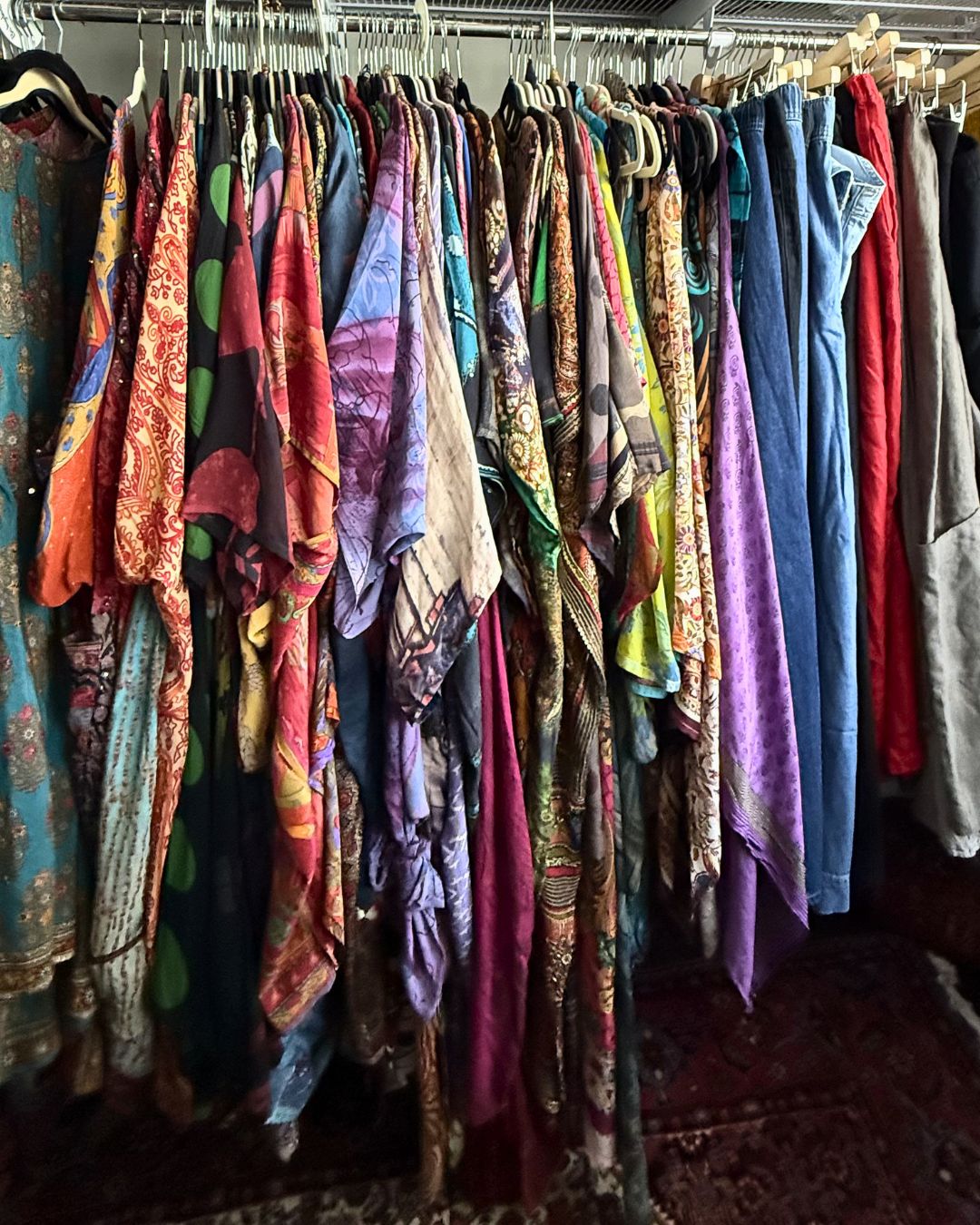
A rail of fabrics that still make them feel visible to themselves.
Somewhere that holds onto pieces of her while the rest of life keeps changing.




Laisser un commentaire
Ce site est protégé par hCaptcha, et la Politique de confidentialité et les Conditions de service de hCaptcha s’appliquent.